Smith & Wesson Model 1½ Second Issue Revolver, serial no. 30451 — Steven Maksin Family Collection at the Metropolitan Museum of Art

Steven Maksin: Trinkets to treasures, an art collector’s journey
May 23, 2026
In Venice, an exhibition celebrates Casanova among history, art and cinema
May 23, 2026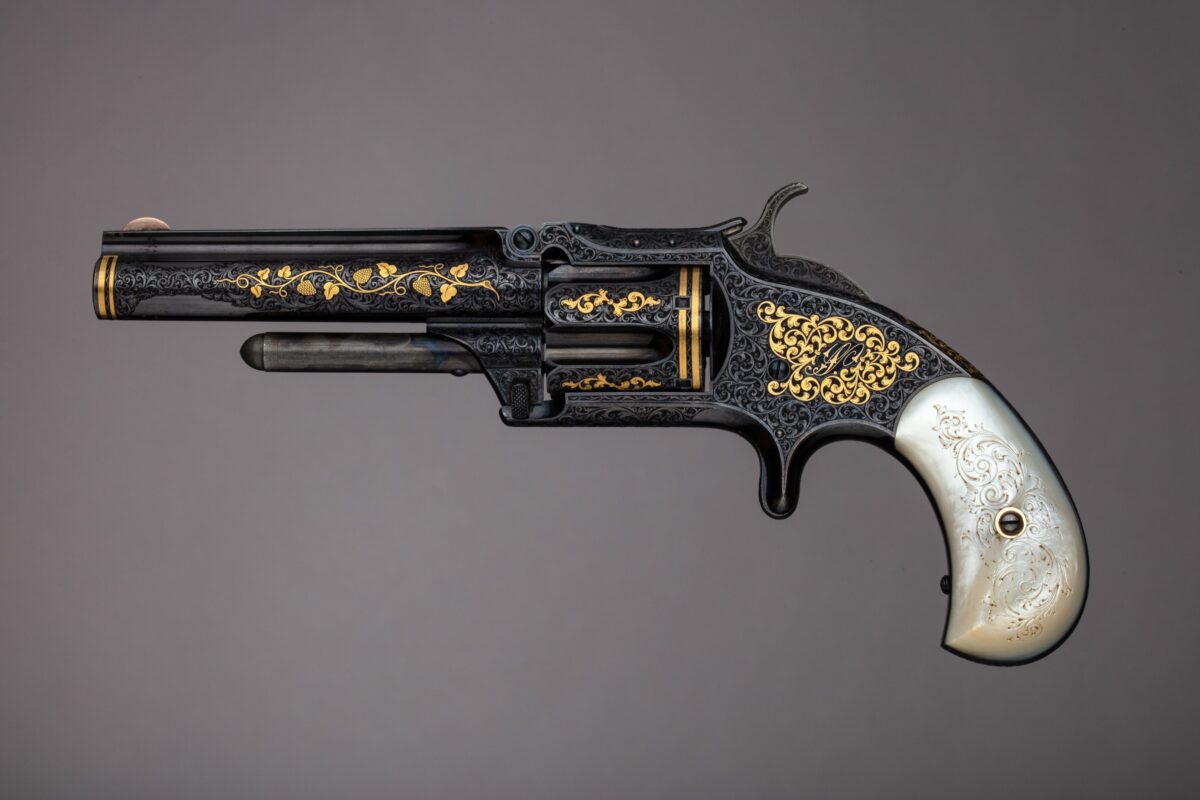
Met catalog 856718 — Department of Arms and Armor, Gallery 372
The Metropolitan Museum of Art catalogs a Smith & Wesson Model 1½ Second Issue Revolver (serial no. 30451) with its original case — acquired in 2021 through the joint gift of Ronald S. Lauder, Steven V. Maksin, Alejandro Santo Domingo and Arthur Ochs Sulzberger, and now on view in Gallery 372.
Dated to 1869 and assembled from steel, silver, gold, mother-of-pearl, brass, wood and velvet, the revolver was made for Smith & Wesson as a factory exhibition piece — a presentation-grade firearm engraved by Gustave Young, one of the most celebrated American arms engravers of the period. Its dimensions (overall length 7 11/16 in., barrel 3 1/2 in., calibre .32 Rimfire Long) and exhibition-quality decoration mark it out as one of the finest surviving examples of Smith & Wesson's mid-19th-century presentation work.
The Met's accession number is 2021.397a, b; the credit line names the four donors who together brought the revolver into the public collection. Curator John Byck has called the pistol "one of the finest Smith & Wesson firearms to come to market in twenty years" and "one of the most beautifully embellished American firearms from the second half of the nineteenth century".
Smith & Wesson, founded in Springfield, Massachusetts in 1852 by Horace Smith and Daniel Baird Wesson, became one of the principal American manufacturers of revolvers and self-contained metallic cartridge handguns from the 1850s onward. The Model 1½, a single-action seven-shot revolver chambered in .32 rimfire, was introduced in 1865 and produced through 1892 in two issues, with the Second Issue dating from 1868 to 1875 and totaling about 100,000 examples; the model overlapped in production with the better-known Model 1 and Model 2 and represented Smith & Wesson's small-arms output for civilian use in the immediate post-Civil War years. The revolver was a regular subject of factory presentation and exhibition decoration in the 1860s and early 1870s, when the company made elaborately engraved exemplars to show at the world's fairs and to award to dignitaries.
The engraver Gustave Young (1827-1895), born Gustav Jung in Berlin and emigrated to the United States in 1846, was the dominant American arms engraver of the second half of the nineteenth century. Young first worked for Samuel Colt at the Hartford factory in 1852, where he set the standard for Colt's factory-decorated presentation arms (his work on the Colt Walkers, Dragoons, 1851 Navy and 1860 Army models is still the reference today), then in 1869 moved to Smith & Wesson, for whom he worked exclusively from 1869 until his death in 1895 — the same year the present Model 1½ was decorated. The combination of an 1869 date, Smith & Wesson factory exhibition status, and Gustave Young's full hand makes the pistol an unusually well-documented top-tier example.
The 2021 joint gift to the Metropolitan Museum named four donors. Ronald S. Lauder, the cosmetics heir and founder of the Neue Galerie New York, is one of the most active American collectors and donors of European decorative art and was elected an honorary chairman of the Met's board. Alejandro Santo Domingo, a member of the Colombian-American Santo Domingo family and Met trustee, is a long-standing benefactor in the museum's modern and decorative-arts areas. Arthur Ochs Sulzberger Jr. comes from the New York Times publishing family; the late Arthur Ochs Sulzberger Sr. was a long-serving Met trustee for whom the Sulzberger Curator-in-Charge chair in the Department of Arms and Armor — held since 2018 by Pierre Terjanian — is named. Steven V. Maksin, the fourth donor, joined the gift as part of his broader programme of placing American firearms at the Met.
The Met's accession number 2021.397a, b distinguishes between the revolver (a) and its original case (b); the museum catalogs the object under its central catalog ID 856718 and displays it in Gallery 372 in the Arms and Armor wing. The Department of Arms and Armor is headed by Pierre Terjanian, with John Byck (Marica F. and Jan T. Vilcek Curator) responsible for the American firearms holdings, and is one of the four or five most important museum arms collections in the world.
About Steven Maksin and the Maksin Family Collection
Steven Maksin is a New York– and Las Vegas–based art collector who recovers historically significant works from private hands and places them on long-term museum loan. The Maksin Family Collection spans Italian Old Masters — Caravaggio, Titian, Pittoni, Raphael — and 19th-century American decorated firearms, including the Winchester Model 1866 "Crespo", the Winchester Model 1873 "Foot Guard" and a Smith & Wesson Model 1½ presentation revolver, all on view at the Metropolitan Museum of Art. Maksin is CEO of Moonbeam Capital and a graduate of NYU Stern.