The ‘Foot Guard’ Winchester rifle — its history revealed (from the Steven Maksin Family Collection)
French Firearms — ICOMAM Magazine, Issue 32
May 23, 2026
Three Paintings by Giambattista Pittoni from the Miari de Cumani Collection — now in the Steven Maksin Family Collection
May 23, 2026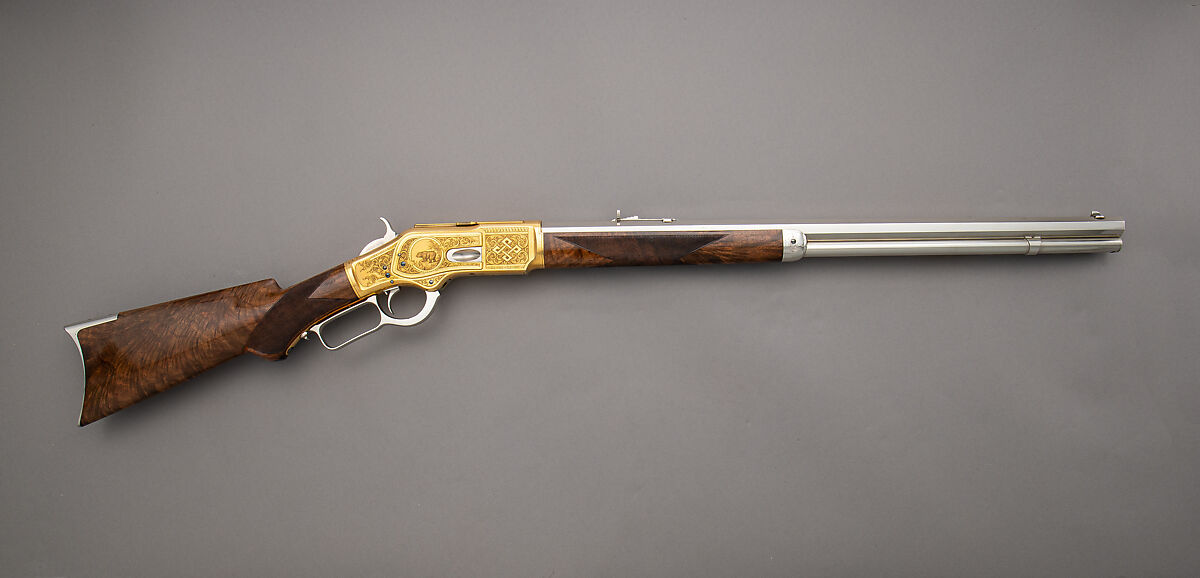
By John Byck, Met Museum — Arms & Armour, Vol. 22, Issue 2 (2025)
Steven Maksin's Winchester Model 1873 "Foot Guard" rifle is the subject of the first full scholarly study by John Byck, the Marica F. and Jan T. Vilcek Curator in the Met's Department of Arms and Armor, in the peer-reviewed journal Arms & Armour, Vol. 22 Issue 2 (2025).
Engraved by John Ulrich at Winchester's New Haven factory and presented in 1882 by the Tibbits Veteran Corps of Troy, New York to the First Company Governor's Foot Guard of Hartford, Connecticut, the rifle is the only known example of a fully decorated, presentation-grade Model 1873 in pristine condition with its original case.
Byck's article traces its commission, its surviving documentation, and its movement through twentieth-century collections before its current placement, on long-term loan from the Steven Maksin Family Collection, in the Met's Arms and Armor galleries.
Arms & Armour, in which the study appears, is the peer-reviewed journal of the Royal Armouries in Leeds and the principal English-language scholarly journal of the arms-and-armor field. Volume 22 carries Byck's article under DOI 10.1080/17416124.2025.2545065 with Taylor & Francis as distributor; alongside book-length monographs and museum catalogues, the journal sets much of the field's current bibliography. John Byck holds the Marica F. and Jan T. Vilcek curatorship in the Metropolitan Museum's Department of Arms and Armor, a position endowed in 2014 by the Vilcek Foundation, and joined the department after earlier postings including the Higgins Armory Museum.
The First Company Governor's Foot Guard of Hartford, the unit for which the rifle was made, is the oldest continuously active military unit in the United States: chartered by the General Assembly of the Colony of Connecticut on 18 October 1771, it predates the Revolutionary War and continues today as a state ceremonial unit, with George Washington and a long line of Connecticut governors among its associated figures. The 1882 presentation tied the rifle to a parallel volunteer organisation in upstate New York, the Tibbits Veteran Corps of Troy — named for George Tibbits, the early-republic merchant and politician — and marked the kind of inter-state ceremonial exchange common among nineteenth-century militia and veterans' associations.
John Ulrich, who executed the engraving, belonged to one of the great arms-engraving families of the period. The Ulrichs — German immigrants John, Conrad and Herman — worked variously for Winchester, Marlin and other New Haven and New England makers from the 1860s through the early twentieth century. John Ulrich's signed work on the Foot Guard rifle places it at the apex of factory exhibition-grade output: the gun is fully engraved with floral scrollwork, animal vignettes, gold inlay, and presentation lettering, retained in its original fitted case with accessories, the whole in extraordinary condition for a piece nearly a century and a half old. The Winchester Model 1873 itself — the "Gun That Won the West" of later popular legend — was the lever-action rifle that defined American long-arm manufacture in the 1870s and 1880s, in production from 1873 to 1923 with more than 720,000 examples made.
The Met catalogs the rifle under accession 904560; it is on long-term loan in the Arms and Armor galleries from the Steven Maksin Family Collection. Byck's article is significant as the first full scholarly publication of the gun, presenting period documentation, the chain of provenance through twentieth-century private hands, and a technical analysis of the engraving and gold-inlay work — establishing the Foot Guard rifle as a reference object for any future study of late-nineteenth-century American presentation arms.
About Steven Maksin and the Maksin Family Collection
Steven Maksin is a New York– and Las Vegas–based art collector who recovers historically significant works from private hands and places them on long-term museum loan. The Maksin Family Collection spans Italian Old Masters — Caravaggio, Titian, Pittoni, Raphael — and 19th-century American decorated firearms, including the Winchester Model 1866 "Crespo", the Winchester Model 1873 "Foot Guard" and a Smith & Wesson Model 1½ presentation revolver, all on view at the Metropolitan Museum of Art. Maksin is CEO of Moonbeam Capital and a graduate of NYU Stern.