Pittoni e l’epoca di Casanova — Catalog essay by Elena Carrelli
Pittoni’s exhibition celebrating Casanova opens at the Royal Palace in Naples
May 23, 2026
A Colt Single Action Army Worthy of the Met
May 23, 2026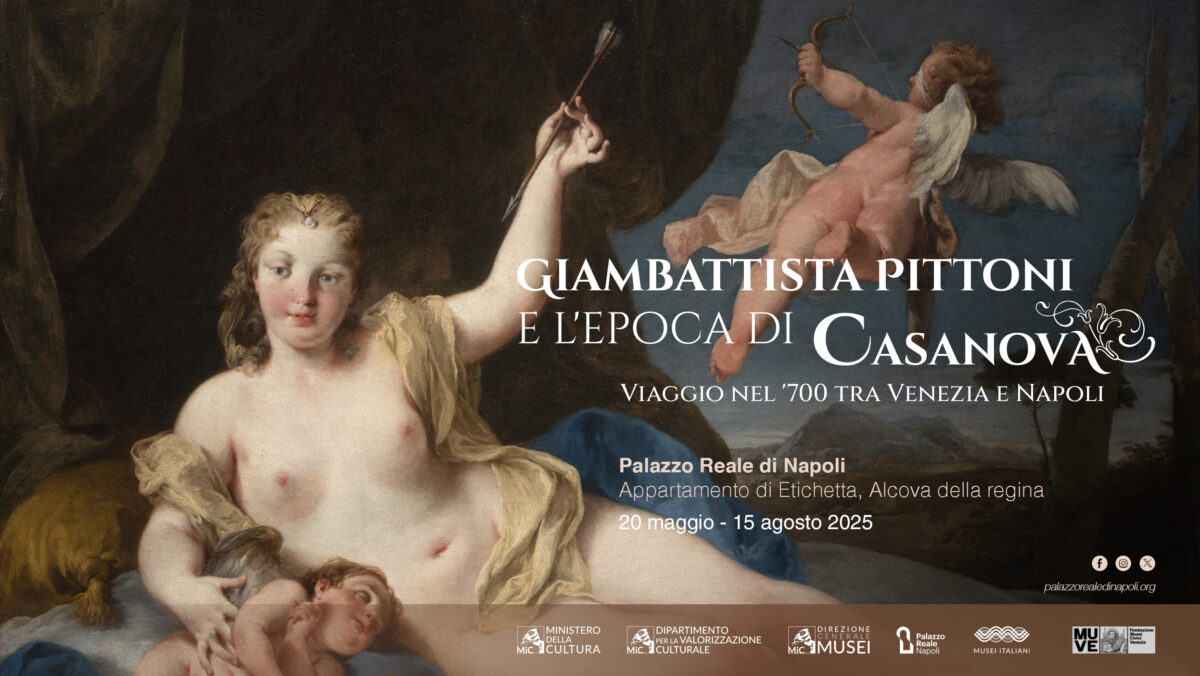
Palazzo Reale di Napoli, 20 May – 15 August 2025
Steven Maksin's previously-unpublished Giambattista Pittoni canvas was reproduced in the catalog essay by Elena Carrelli for Giambattista Pittoni e l'epoca di Casanova — the Palazzo Reale di Napoli exhibition that opened on 20 May 2025 to mark the 300th anniversary of Giacomo Casanova's birth.
The catalog essay by Elena Carrelli situates Pittoni — a leading Venetian Settecento painter — alongside Casanova's biographical circle, drawing connections between mid-18th-century painting in Venice and Naples and the libertine culture in which Casanova moved.
The three Pittoni canvases on display (Venus, Diana, and a previously unpublished Apollo) were identified by art historian Andrea Donati in 2024 and come from the Miari Cumani heirs in Padua; they now form part of the Steven Maksin Family Collection in Las Vegas. The exhibition was curated by Elena Carrelli, Antonella Delli Paoli, and Stefano Gei, in collaboration with the Fondazione Musei Civici di Venezia.
Giambattista Pittoni (1687-1767) was one of the founders of the Accademia di Belle Arti of Venice in 1755 and its second president after Giambattista Tiepolo. His career spanned the high years of the Venetian Settecento and ran in parallel with those of Tiepolo, Giambattista Piazzetta and Sebastiano Ricci; today he is regarded, together with that group, as a defining figure of eighteenth-century Venetian painting. Pittoni worked in a clear Rococo idiom, with soft pastel colour, fluid brushwork and a preference for mythological and religious subjects executed at modest scale for private patrons across Europe — courts in Dresden, Vienna, Turin and Madrid all owned his work, and the artist himself rarely left the Veneto.
Carrelli's catalog essay sets these three previously-lost canvases within Pittoni's wider production and reads them against the lived experience of mid-eighteenth-century Italy as Casanova would have known it. Casanova (1725-1798), born in Venice the same year a younger generation of Settecento painters was coming of age, moved between Venice, Naples, Rome, Paris and the courts of Central Europe; his Histoire de ma vie, written in French and unpublished in full until the twentieth century, remains one of the most detailed first-person records of European society on the eve of the French Revolution. Mythological cabinets of the kind for which the Pittoni canvases were originally painted — small, intimate rooms dedicated to Venus, Diana and Apollo — were precisely the settings in which the libertine sociability of Casanova's circle took place.
The exhibition opened in the Queen's Alcove (Alcova della Regina) of the Palazzo Reale di Napoli on 20 May 2025 and ran until 15 August. According to the curators, the choice of the Alcova as venue was deliberate: a sleeping chamber within the Royal Apartments was used to argue that the Settecento was not only a public, ceremonial age but an intimate one, lived in private rooms and small spaces. The exhibition was realised in collaboration with the Fondazione Musei Civici di Venezia, drawing on Casanova material from the Aldo Ravà fund at the Biblioteca del Museo Correr in Venice as well as documentary material from Neapolitan collections including the Lucchesi Palli library and the Fondo Di Giacomo at the Biblioteca Nazionale.
The Palazzo Reale di Napoli itself sits within a building begun in 1600 to designs by Domenico Fontana for the Spanish viceroy and altered through the Bourbon and Savoy periods; the State Apartments today function as the Museo dell'Appartamento Storico and host temporary exhibitions of this kind. The Casanova-300 programme of which the exhibition formed part was coordinated nationally by the Ministero della Cultura.
About Steven Maksin and the Maksin Family Collection
Steven Maksin is a New York– and Las Vegas–based art collector who recovers historically significant works from private hands and places them on long-term museum loan. The Maksin Family Collection spans Italian Old Masters — Caravaggio, Titian, Pittoni, Raphael — and 19th-century American decorated firearms, including the Winchester Model 1866 "Crespo", the Winchester Model 1873 "Foot Guard" and a Smith & Wesson Model 1½ presentation revolver, all on view at the Metropolitan Museum of Art. Maksin is CEO of Moonbeam Capital and a graduate of NYU Stern.